
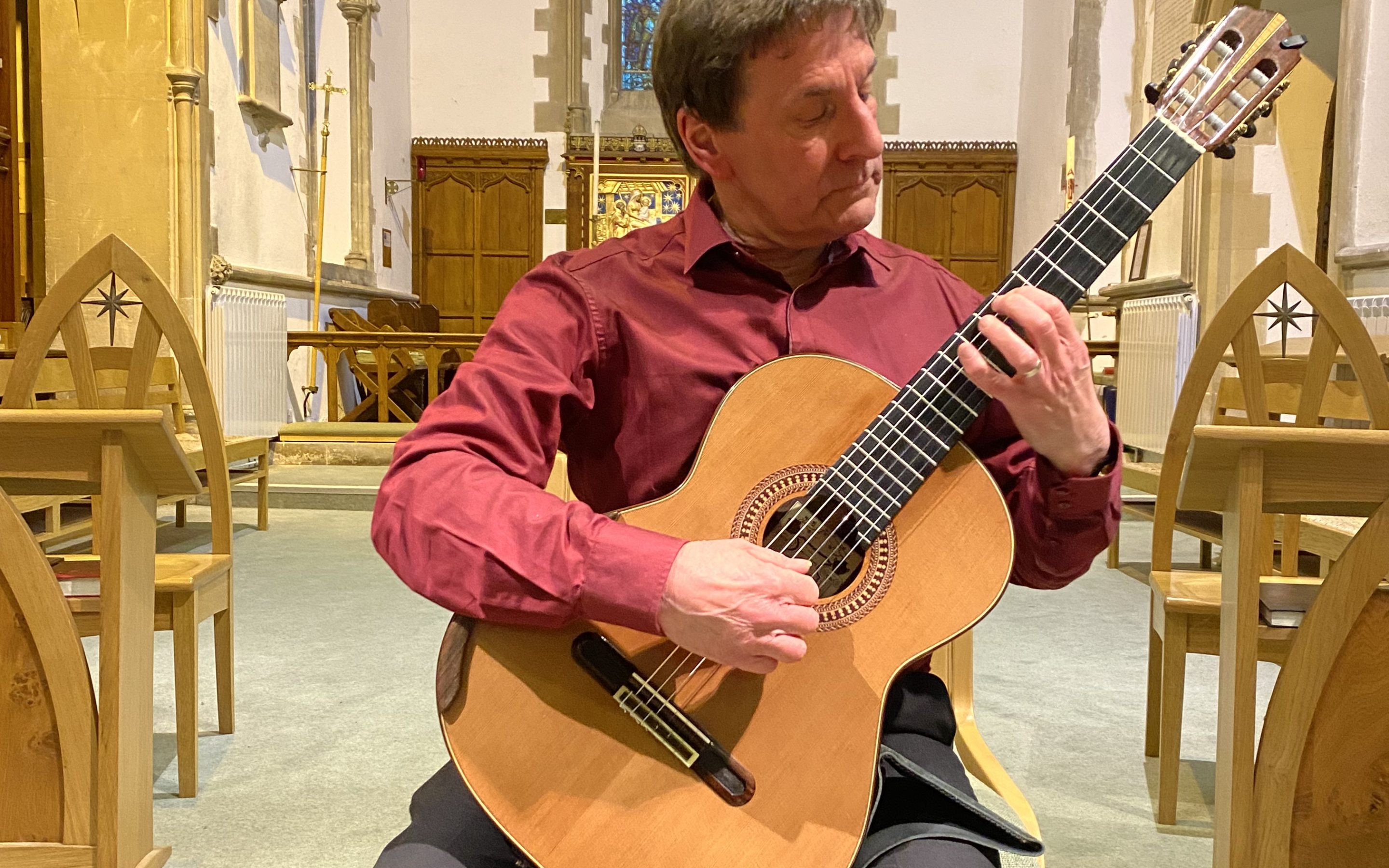
Gary Jordan treated us to the history of the Spanish guitar, accompanied by a recital of his beautiful playing. Gary started playing guitar at 17 as a hobby which grew alongside his career as an engineer. In 2014 he became a full time guitarist and guitar teacher, gaining a list of impressive music qualifications.
The first known image of a guitar like instrument comes from Turkey and is 3,500 years old. It shows a waisted bodied lute like instrument with a neck and four strings called a Chartar – so it’s easy to see how mispronunciation could have morphed this into Guitar over time.
Four coursed instruments, with four pairs of strings, dominated until the 1500’s. Spanish musicians favoured a form of baroque guitar known as the Vihuela which was much loved by Queen Isabella. Mariachi groups still use a version of the Vihuela today.
Jump forward a century and a fifth string has been added and this version of the instrument dominates until the 1800’s. This is when the final sixth string was added and guitars gained a narrower waist. These were smaller than modern instruments. The final steps towards the guitar as we know it were made by Antonia Torres Jurado,a Spanish cabinet maker who also made guitars. These changes lead to guitars which were louder with a more controlled sound.
With each step in the evolution of the guitar Gary spoke about the music written for the guitar and how it developed over time before playing a piece of music from the era. If you weren’t able to join us you can find out more about Gary and hear him play on his website garyjordanguitar.uk and find out about recitals he’s giving over the next few months including one in Bradenham in June.
While we don’t have recordings of Gary playing the music he delighted us with at the meeting you can listen to the pieces played by other guitarists on YouTube:
Vicente Gomez – Granada Arabe
John Dowland – Fantasia
Luis de Narvaez – Guardame Las Vacas
Gaspar Sanz – Canarios
Fernando Sor – Variations on a theme by Mozart
Francesco Tarrega – Memories of the Alhambra
Mario Giuliani – Grand Overture
Federico Moreno-Torroba – Nocturno
Joaquin Turina – Soleares
Heitor Villa-Loboa – Prelude no1.
Antonio Lauro – Venezuelan Waltz ‘Andreina”
Stanley Myers – Cavatina
Isaac Albeniz – Asturias