
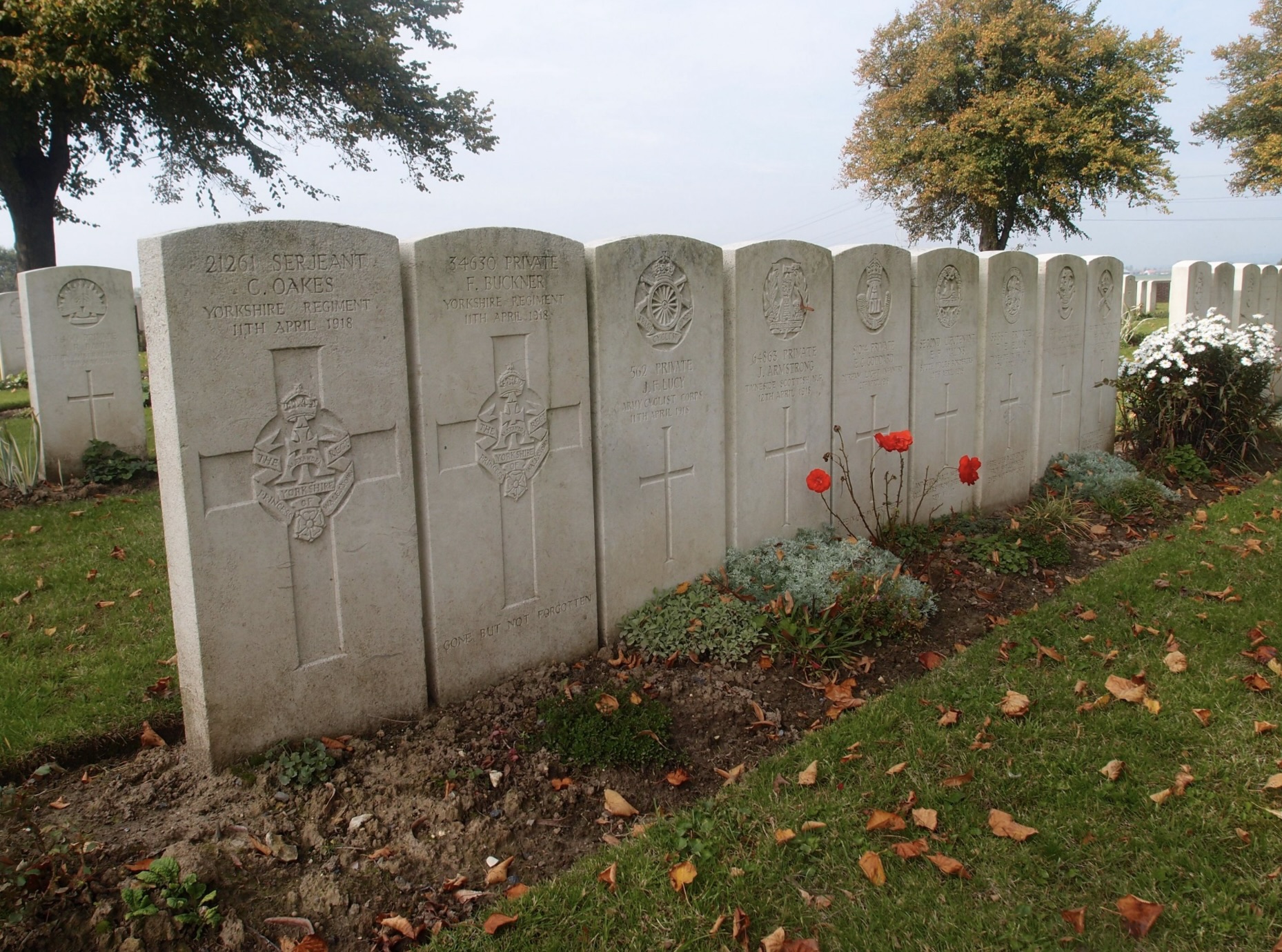
Sue Wright, a volunteer with The Commonwealth War Graves Commission (CWGC), came to speak to us about the origins of the Commission and what they do. She is one of 2,500 volunteers worldwide who support their work by giving tours around sites and talks to groups. They also keep an eye on the war graves within a particular area, this involves learning how to clean the headstones..
The CWGC owes its’ existence to the dedicated persistence of Sir Fabian Ware. At 45 he was considered too old to fight in the First World War and went to the Western Front to serve on the mobile ambulances. He saw how many soldiers were buried on the battlefields and lobbied for a way to commemorate their sacrifice on a permanent basis. In 1917, the then Imperial War Graves Commission was established by Royal Charter. Before this soldiers were not given their own named headstone.
People from around the Commonwealth came to fight in both World Wars from the armed forces, auxiliary services, merchant navy and other associated groups. The CWGC involves six member Governments – Australia, New Zealand, India, South Africa, Canada and the UK, which pays 78% of the costs. The ongoing work of the CWGC includes the maintenance of cemeteries and headstones around the globe, keeping records of the service men and women buried at each site, creating and maintaining their headstones, commemorating the missing and running commemoration services.
After the armistice the bodies of the fallen were recovered from the battlefields and buried at CWGC cemeteries created to honour their sacrifice. From the beginning the CWGC has employed the best architects to design memorials, headstones and the layout of their many cemeteries around the world. The headstones and memorials are permanent, and show the Regimental unit or badge, the person’s service particulars, the date they died and their age, a religious emblem and in some cases a personal inscription chosen by their families. There is no indication of rank or status and the headstones are all the same shape and size to add to the sense of peace and respect these sites rightfully imbue. The degree of care taken by the CWGC even extends to developing a dedicated font for the commission, this can be read from up to a 45 degree angle to make it easier for family members to find their loved one’s resting place. The larger cemeteries include memorials to the missing, for example the Menin Gate at Ypres lists 54,000 names, and there are similar memorials around the world. In the UK we have memorials to the missing in Portsmouth, 25,000 names, Plymouth and Chatham.
The scale of their work is breathtaking. Over 1.7 million Commonwealth service men and women are commemorated, from 14 – 91 years of age. 1.1 million headstones are maintained at 23,000 locations worldwide. There are also 68,000 on the Civilian Roll of Honour in Westminster Abbey. Not all of these locations are the huge cemeteries found at sites such as Ypres. Our very own St Mary’s Churchyard has three War Grave Commission Headstones from the Second World War, Flight Lieutenant Alexander Noel David, Flight Sergeant Albert Edward Saunders and Lieutenant Thomas George Shackleton. The work of the CWGC continues, as we move into times of climate uncertainty their 900 gardeners around the world are finding sustainable ways to garden and maintain their sites. This includes providing areas for wildlife and providing bug hotels while looking at how to maintain the essential characteristics of each site.
Sue finished her talk by sharing how we can find out more information, whether that’s finding a loved one, volunteering with the CWGC or donating towards their work. The work of the CWGC is truly moving, long may it continue. Least we forget.
Image: British soldiers’ graves in La Kreule Military Cemetery near Hazebrouck in France from the longlongtrail.co.uk website.